
What size dumpster do I need for a roofing project?
You’re planning a roof replacement and your roofing contractor mentioned needing a roofing dumpster rental for your project. But what size dumpster do I need for a roofing project? If your roof measures 2,500 square feet (approximately 25 “squares” in roofing terminology), you’ll typically need a 20 yard dumpster for single-layer shingle removal. Roof size, number of existing shingle layers, and shingle type determine capacity requirements. A 10 yard dumpster handles small roofs up to 1,500 square feet (15 squares), a 20 yard accommodates most residential roofs from 1,500-3,500 square feet (15-35 squares), and a 30 yard serves large roofs over 3,500 square feet or multi-layer tear-offs. For Apopka roofing projects, proper sizing matters because shingles are heavy (2-4 pounds per square foot) and compact well, filling dumpsters by weight before volume in some cases. Understanding the relationship between roof squares and dumpster capacity prevents costly mistakes—ordering too small requires expensive second rental mid-project, ordering too large wastes money on unused capacity.
This guide answers what size dumpster do I need for a roofing project and explains how to calculate size from roof measurements, compare options for different roof sizes, and account for roofing-specific factors in Apopka.
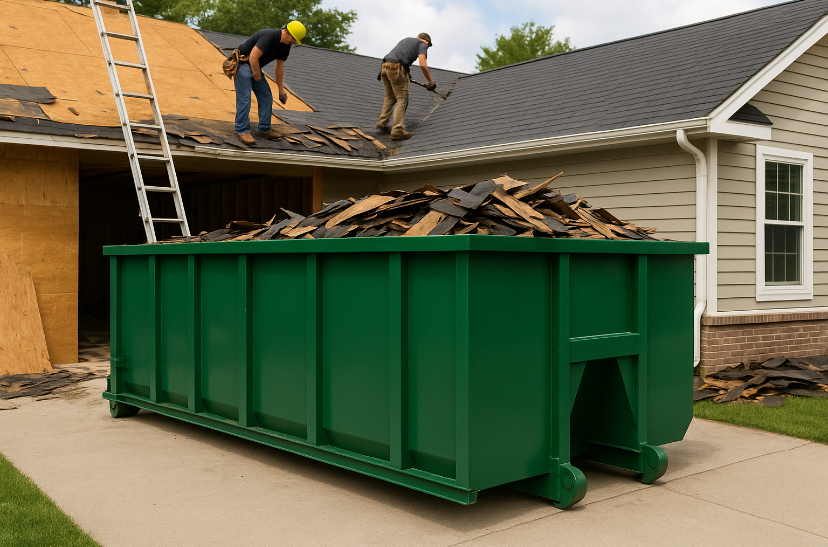
What Size Dumpster Do I Need for a Roofing Project?
Roofing dumpster size depends on roof square footage and number of shingle layers:
Calculation method: Measure roof square footage, divide by 100 to get “squares” (roofing industry standard measurement). Each square (100 square feet) of single-layer shingles equals approximately 0.5 cubic yards of debris.
Size by roof size (single-layer tear-off):
- 10 yard dumpster: Roofs up to 1,500 square feet (15 squares); generates 7-8 cubic yards debris; small homes, garages, sheds
- 20 yard dumpster: Roofs 1,500-3,500 square feet (15-35 squares); generates 8-18 cubic yards debris; most common residential size
- 30 yard dumpster: Roofs over 3,500 square feet (35+ squares) OR multi-layer tear-offs; large homes, multi-story, or removing 2+ layers of old shingles
Multi-layer adjustment: Double or triple capacity for 2-layer or 3-layer tear-offs. A 2,000 square foot roof with 2 layers needs a 30 yard not 20 yard.
Apopka roofing: Most residential roofs 2,000-3,000 square feet equal 20-30 squares requiring 20 yard dumpster. Roofing contractors standardize on 20 yard for efficiency.
Weight consideration: Shingles are heavy (2-4 pounds per square foot). A 20 yard dumpster weight limit (2-4 tons) is adequate for most residential roofs but large roofs may approach limits.
Get roofing dumpster for your project → roofing dumpster rental in Apopka.
How to Calculate Dumpster Size from Your Roof Measurements
Teaching you how to measure your roof and convert measurements to appropriate dumpster size provides the calculation framework for your sizing decision.
Understanding Roofing “Squares” Measurement
The roofing industry measures in “squares” where 1 square equals 100 square feet of roof area [SOURCE: Roofing industry measurement standards]. A typical residential home with a 2,000 square foot roof equals 20 squares (2,000 ÷ 100). Contractors quote roofing projects in squares, making this the standard reference. Knowing your roof’s square count simplifies dumpster sizing. If you’re unsure of roof size, measure your house footprint and add 10-20% for roof overhang and pitch.
Debris Volume Per Square Formula
Each square (100 square feet) of single-layer asphalt shingles generates approximately 0.5 cubic yards of debris when removed. This includes shingles, underlayment, flashing, ridge caps, and valley materials. The formula: roof squares × 0.5 = cubic yards of debris needed. For example, a 25 square roof × 0.5 = 12.5 cubic yards of debris requiring a 20 yard dumpster which provides buffer. This formula accounts for typical tear-off debris compaction when shingles break into manageable pieces.
Single-Layer Versus Multi-Layer Calculations
Single-layer tear-off uses the 0.5 cubic yards per square standard calculation. A 2-layer tear-off (removing the old layer plus the previous layer underneath) doubles the volume: squares × 1.0 cubic yards. A 3-layer tear-off triples it: squares × 1.5 cubic yards. Many older homes have multiple shingle layers from previous re-roofs done without tear-off. For example, a 20 square roof with 2 layers equals 20 × 1.0 = 20 cubic yards requiring a 30 yard dumpster not 20 yard. Inspect your roof edge or attic to count layers before ordering a dumpster.
Pitch and Complexity Factors
Steep pitch roofs (8/12 pitch or greater) generate slightly more debris due to additional underlayment and waste. Complex roofs with dormers, valleys, and hips create more cut waste and flashing debris, adding 10-15% volume. Simple gable roofs generate predictable volume using standard formulas. Hip roofs with multiple planes add complexity. If your roof has significant complexity, add 1-2 cubic yards to your calculated need or size up one dumpster size for buffer.
Quick Sizing Reference Table
Ten to 15 squares (1,000-1,500 square feet) equals 10 yard dumpster. Fifteen to 25 squares (1,500-2,500 square feet) equals 20 yard dumpster. Twenty-five to 35 squares (2,500-3,500 square feet) equals 20 yard at full capacity or 30 yard with buffer. Thirty-five to 50 squares (3,500-5,000 square feet) equals 30 yard dumpster. Over 50 squares (5,000+ square feet) equals 30 yard plus additional or 40 yard. This applies to single-layer tear-offs; multi-layer requires sizing up.
Roofing Dumpster Size Recommendations by Roof Type
Specific size recommendations for common residential roof scenarios help you match your roof to the appropriate dumpster.
Small Roofs and Outbuildings (10 Yard Dumpster)
Garages measuring 400-600 square feet (4-6 squares), small sheds at 200-400 square feet (2-4 squares), small ranch homes under 1,200 square feet (10-12 squares), and single-story additions or room additions of 500-800 square feet fit in 10 yard dumpsters. A 10 yard dumpster holds 7-10 cubic yards, accommodating these smaller tear-offs. It’s adequate for projects generating under 15 cubic yards of debris. Most professional roofers skip 10 yard for inefficiency, preferring 20 yard even on small jobs which allows disposal flexibility and avoids capacity concerns.
Most Residential Roofs (20 Yard Dumpster – Industry Standard)
Ranch homes of 1,200-2,000 square feet (12-20 squares), two-story homes with 1,500-2,500 square feet total footprint equaling 15-25 squares of roof area, and typical suburban homes of 2,000-3,000 square feet total equaling 20-30 squares all use 20 yard dumpsters. A 20 yard dumpster holds 20 cubic yards, accommodating 15-35 squares of single-layer tear-off with buffer. This is the most common residential roofing dumpster size in Apopka and nationwide. It provides adequate capacity without significant waste, fits residential driveways comfortably, and allows roofing contractors to standardize on one size that fits most jobs with familiar capacity and predictable costs.
Large Homes and Multi-Layer Tear-Offs (30 Yard Dumpster)
Homes over 3,000 square feet of footprint equal 30-40+ squares. Two-story homes of 2,500-3,500 square feet equal 25-35 squares. Any home with a 2-layer shingle tear-off regardless of size doubles debris volume. Complex roofs with extensive dormers and valleys generate additional waste. A 30 yard dumpster holds 30 cubic yards, accommodating 35-50 squares of single-layer OR 20-30 squares of two-layer tear-off. This size is necessary when 20 yard capacity proves insufficient. The cost difference from 20 yard typically runs $50-100 in Apopka—a minimal premium for avoiding a second rental.
Flat and Low-Slope Roofs
Commercial flat roofs with built-up roofing (BUR) or modified bitumen generate different debris volumes than residential shingles. Flat roof tear-off includes multiple membrane layers, insulation, and ballast (gravel), significantly increasing weight and volume. Low-slope residential roofs (under 3/12 pitch) often use rolled roofing or modified bitumen, creating denser debris. Consult your dumpster provider for flat roof sizing as calculations differ from shingle formulas. Weight becomes the limiting factor before volume with flat roof materials.
Specialty Roofing Materials
Wood shake or shingle roofs generate more volume than asphalt because they compress less and create bulkier debris. Tile roofs are extremely heavy, requiring weight-capacity consideration not just volume. Slate roofs present similar weight concerns to tile. Metal roofing generates minimal debris since metal panels are recyclable with minimal volume. Specialty materials may need different sizing approaches than standard asphalt shingle formulas. For wood shake, add 25-30% to calculated volume. For tile, focus on weight limits—you may need multiple smaller dumpsters rather than one large one.
Rent roofing dumpster for your roof size.
Roofing Debris Characteristics Affecting Dumpster Sizing
Unique characteristics of roofing debris affect capacity and sizing decisions, particularly regarding weight, compaction, and materials.
Shingle Weight and Density
Asphalt shingles weigh 2-4 pounds per square foot when installed, with architectural or dimensional shingles being heavier than 3-tab [SOURCE: Shingle manufacturer specifications]. One square (100 square feet) of shingles weighs 200-400 pounds. A 25 square roof equals 5,000-10,000 pounds of shingles (2.5-5 tons) plus underlayment and flashing. A 20 yard dumpster typically has a 2-4 ton weight capacity—adequate for most residential roofs but large roofs approach these limits. Weight is rarely the limiting factor for properly sized dumpsters on residential roofs, but it’s a consideration for very large homes or multi-layer tear-offs.
Debris Compaction Characteristics
Shingles break into irregular pieces during tear-off, creating natural compaction as they’re loaded. Torn shingles stack and compress better than bulky construction materials. Roofing debris fills 70-85% of calculated volume due to compaction. This explains why a 25 square roof generating a calculated 12.5 cubic yards fits comfortably in a 20 yard dumpster. Proper loading—shingles tossed from the roof landing in the dumpster—achieves good compaction naturally. Hand-stacking shingles wastes time and doesn’t significantly improve compaction.
Materials Beyond Shingles Included in Tear-Off
Underlayment (felt paper or synthetic) adds minimal volume but is included in debris. Drip edge and eave flashing (aluminum or galvanized metal) contribute small volume but are part of the tear-off. Ridge caps and hip shingles (specialty pieces) are included in the shingle count. Valley flashing (metal or roll roofing) adds minimal volume. Chimney flashing if replaced, old boots around plumbing vents, and similar components are included. The standard formula (0.5 yards per square) accounts for these typical tear-off materials. Unusual situations like removing decking (plywood or OSB sheathing) significantly increase volume—add 50-75% to your calculated need.
Disposal Restrictions and Prohibited Items
Standard roofing dumpsters accept asphalt shingles, underlayment, metal flashing, and typical roofing materials. You cannot dispose of hazardous materials (old caulk or sealants if contaminated), treated wood if replacing decking, or significant amounts of nails separated from debris. Most areas allow composite shingles in construction dumpsters. Some recycling facilities prefer shingle-only loads with no mixed debris for recycling programs. Apopka accepts standard roofing debris in construction dumpsters. Verify with your provider if disposing of specialty materials like tile, slate, or cedar shake in large quantities.
Loading Efficiency and Fill Level
Roofing debris loads from the roof directly into the dumpster, utilizing gravity-assisted compaction. This achieves efficient filling without hand-stacking. Materials should not extend above dumpster sides per transportation regulations. Roofing debris typically fills the dumpster evenly due to the throwing pattern from the roof. Proper dumpster placement close to the roof edge (but protecting landscaping and driveways) maximizes loading efficiency. Experienced roofers achieve 80-90% capacity utilization. DIY homeowners may achieve only 70-80% if loading inefficiently or not breaking down materials.
[CRM Roll Off regularly works with Apopka roofing contractors and homeowners on capacity planning. We’ve found that most 2,000-2,500 square foot single-story homes with single-layer tear-offs fill a 20 yard dumpster to approximately 75-85% capacity, confirming the 0.5 cubic yards per square calculation. One recent project involved a 3,200 square foot two-story home (32 squares) with an unexpected second layer of shingles discovered during tear-off. The contractor had ordered a 20 yard based on single-layer assumptions. The dumpster filled completely at roughly 60% project completion, requiring an emergency second 20 yard delivery. This doubled the waste disposal cost and delayed the project by half a day. We now recommend contractors verify layer count before ordering, particularly on homes built before 1995 when layering over old shingles was more common practice.]
Order roofing dumpster in Apopka.
Common Roofing Dumpster Sizing Mistakes to Avoid
Identifying frequent errors in roofing dumpster sizing prevents costly mistakes through specific warnings and guidance.
Underestimating Multi-Layer Tear-Offs
The most common mistake—homeowner or contractor assumes single-layer tear-off without inspecting the roof edge. They discover a second (or third) layer of old shingles once tear-off begins. A 20 square roof calculated for 10 cubic yards (20 × 0.5) but actually having 2 layers equals 20 cubic yards needing a 30 yard not 20 yard. The 20 yard dumpster fills when the project is only 50% complete, requiring emergency second rental adding $350-450 cost plus project delay. Solution: inspect the roof edge or attic before ordering to count shingle layers accurately. When in doubt, ask previous homeowners or check building permits for past re-roofs done without tear-off.
Not Accounting for Roof Pitch and Complexity
Steep roofs (8/12 pitch or greater) generate 10-15% more debris than calculated due to additional safety measures, more underlayment waste, and cut waste on difficult pitches. Complex roofs with dormers, multiple valleys, hips, and turrets create 15-20% more debris from cutting around obstacles and additional flashing. Assuming a simple gable roof formula when the roof is actually complex leads to undersizing. Hip roofs require more shingles to cover the same square footage than gable roofs, creating more waste during installation and therefore more during tear-off. Solution: add buffer by sizing up to the next dumpster size for steep or complex roofs.
Choosing 10 Yard to Save Money on Medium Roofs
Fifteen to 20 square roofs (1,500-2,000 square feet) technically fit in a 10 yard dumpster by calculation (7.5-10 cubic yards debris). Homeowners choose 10 yard ($250-325) over 20 yard ($350-450) to save $100-125. The 10 yard fills to absolute capacity, leaving no buffer for miscalculation or additional debris like old decking repairs, extra flashing, or cleanup debris. Slight miscalculation or finding a second layer results in an overfull dumpster or need for a second rental. Professional roofers avoid 10 yard even on small jobs because the $100-125 savings isn’t worth the capacity risk and potential project delay. A 20 yard provides working room and peace of mind.
Forgetting Tear-Off Happens Quickly
A roofing tear-off crew removes a typical residential roof in 4-8 hours, faster than most debris-generating projects. The dumpster fills rapidly and needs adequate capacity from the start because there’s no opportunity to “see how full it gets” and order more. Unlike a remodel where you can assess debris accumulation over days or weeks, roofing tear-off completes the same day, requiring the correct size immediately. An undersized dumpster becomes apparent when the roof is 60-75% torn off and the dumpster is completely full. This requires stopping work, arranging emergency pickup, and waiting for second dumpster delivery. Solution: size correctly from the start accounting for rapid debris generation.
Ignoring Dumpster Placement and Roof Access
Ordering the correct size but placing the dumpster too far from the roof edge (protecting landscaping or vehicles) creates loading inefficiency. Roofers must throw debris farther or wheelbarrow material to the dumpster, wasting time. Debris landing outside the dumpster creates cleanup work. Positioning the dumpster under the roof edge where most tear-off occurs maximizes efficiency. The driveway closest to the roof typically provides optimal placement. Discuss placement with your roofing crew before delivery to ensure the dumpster is accessible for rapid loading. Proper placement can effectively increase capacity by improving loading efficiency.
[CRM Roll Off has helped numerous Apopka customers avoid these common mistakes through our free sizing consultations. One homeowner planning a DIY roof replacement on their 1,800 square foot ranch home initially planned to order a 10 yard dumpster to minimize cost. After discussing the project and confirming single-layer tear-off (18 squares × 0.5 = 9 cubic yards calculated), we recommended the 20 yard instead for $75 more. During the actual tear-off, the homeowner discovered rotted decking around the chimney requiring replacement of approximately 40 square feet of plywood. This additional debris, combined with the shingle volume, filled the 20 yard to about 90% capacity. A 10 yard would have overflowed, requiring either overflow fees or a second rental. The modest upfront investment in the larger size prevented a much costlier mistake.]
Avoid sizing mistakes—get free consultation
Choosing the Right Roofing Dumpster Size for Your Apopka Project
An actionable decision framework specific to Apopka transitions to service engagement with clear next steps.
Decision Framework for Roofing Projects
(1) Measure roof square footage by measuring your house footprint and adding for overhang while accounting for pitch. (2) Convert to squares by dividing by 100. (3) Count shingle layers by inspecting the roof edge or attic access. (4) Calculate debris: single-layer equals squares × 0.5, multi-layer equals squares × 1.0 (or × 1.5 for 3 layers). (5) Select size: under 10 cubic yards equals 10 yard (or 20 yard for buffer), 10-18 cubic yards equals 20 yard, over 18 cubic yards equals 30 yard. (6) Add buffer for steep or complex roofs or uncertainty.
Apopka Residential Roof Characteristics
Most Apopka homes built in the 1980s through 2000s range from 1,500-2,500 square feet, equaling 15-25 squares. A typical single-story ranch of 1,200-1,800 square feet equals 12-18 squares requiring a 20 yard. Two-story homes of 2,000-3,000 square feet total equal 20-30 squares requiring 20-30 yard depending on single or multi-layer tear-off. Florida’s climate means roofs typically have a 20-25 year lifespan, requiring replacement rather than repair when reaching end of life. Many homes are approaching the age where original roofs need replacement, creating steady roofing dumpster demand.
Single-Layer Versus Multi-Layer Prevalence
Florida building code changes over decades affect whether homes have single or multiple shingle layers. Homes built or re-roofed pre-1990s are more likely to have multiple layers from previous re-roofs done without tear-off as a cost savings measure at the time. Current best practice involves tearing off old shingles before new installation for better roof performance, longer lifespan, and code compliance. Inspect your Apopka home’s roof edge before ordering a dumpster. Seeing two distinct shingle layers means doubling your capacity calculation. When in doubt, ask your roofing contractor to verify layer count during the estimate.
Roofing Contractor Coordination
If hiring a professional roofer, ask the contractor for dumpster size recommendation based on their roof measurement and inspection. Experienced roofers know the exact square count and layer situation. Some roofing contractors include dumpster rental in their quote—they order and coordinate everything. If you’re ordering the dumpster separately, provide the contractor’s square count and layer information to the dumpster company for accurate sizing. Coordinate delivery timing: the dumpster should arrive the morning of tear-off, not days early sitting empty or late causing tear-off delay. Schedule pickup for end of day after tear-off completes or the next morning.
Cost Optimization and Sizing Strategy
A 20 yard dumpster costs $350-450 in Apopka, a 30 yard costs $400-500—only a $50-100 difference for 50% more capacity [SOURCE: Apopka roofing dumpster pricing]. If your calculation shows 16-20 cubic yards (borderline 20 yard capacity), spending $50-100 more for a 30 yard provides buffer, avoiding a $350-450 second rental if you miscalculated. Roofing contractors often standardize on 20 yard regardless of minor size variations—an 1,800 square foot roof or 2,200 square foot roof both get 20 yard because efficiency and familiarity outweigh minor capacity optimization. For homeowners: when uncertain between two sizes, choose larger. Peace of mind and avoiding project delay are worth the modest premium. CRM Roll Off provides free sizing consultations for Apopka roofing projects. Provide your roof square footage and layer count, and receive our recommendation.
Ready to order? Rent roofing dumpster or call for sizing help.
Sizing Your Roofing Dumpster Correctly
Roofing dumpster size depends on roof square footage and shingle layers. The calculation method involves measuring roof square footage, dividing by 100 to get squares, with each square of single-layer shingles equaling approximately 0.5 cubic yards of debris. A 10 yard dumpster handles roofs up to 15 squares, a 20 yard accommodates 15-35 squares as the industry standard, and a 30 yard serves roofs over 35 squares or multi-layer tear-offs.
Most Apopka residential roofs measuring 2,000-3,000 square feet equal 20-30 squares, requiring a 20 yard dumpster for single-layer tear-offs. Multi-layer tear-offs double or triple debris volume—a 2,000 square foot roof with 2 layers needs a 30 yard not 20 yard. Inspect your roof edge or attic to count layers before ordering.
Common mistakes include underestimating multi-layer tear-offs, not accounting for roof pitch and complexity, choosing 10 yard to save money on medium roofs, forgetting tear-off happens quickly requiring adequate capacity from the start, and ignoring dumpster placement affecting loading efficiency. Professional roofers standardize on 20 yard for most residential jobs, providing adequate capacity without significant waste.
Weight considerations matter as shingles weigh 2-4 pounds per square foot, but 20 yard dumpster weight limits (2-4 tons) adequately handle most residential roofs. Roofing debris compacts well, filling 70-85% of calculated volume due to natural compression when shingles break during tear-off.
CRM Roll Off provides free sizing consultations for Apopka roofing projects. We deliver the morning of tear-off and pick up when you’re finished, keeping your project on schedule with properly sized capacity.
Planning a roof replacement in Apopka? CRM Roll Off provides roofing dumpsters sized specifically for your project. Tell us your roof square footage and number of shingle layers, and we’ll recommend the perfect size—20 yard for most residential roofs, 30 yard for large homes or multi-layer tear-offs. Our roofing dumpsters deliver the morning of tear-off and pick up when you’re finished, keeping your project on schedule. Call (321) 228-0245 for roofing dumpster sizing help or rent your roofing dumpster online.